

Antisemantic antisemitism and the propaganda of confusion
How racist stupidity was co-opted to assist genocide in Palestine

Warning: do not use a translation program to interpret this text, you will almost certainly misunderstand it.
Insisting that the ‘semitic’ in the word ‘antisemitic’ carries a different meaning to ‘Semitic’ as used alone, is dogmatic and nonsensical. As a weapon of racist propaganda, it serves to shut down discussion and eradicate the history, and identity, of non-Jewish Semites. It’s easy to see how its use aims to eviscerate the complicated history of the region and replace it with an ontology of Zionist hegemony. The outcome of this duplicitous linguistic trick, unopposed by weak-minded Western governments, is now present in the desperate, emaciated faces of Palestinian children being deliberately starved to death.
The word antisemitism was first deployed to spread hatred toward Jews in the late 19th Century. Organizations, such as the International Holocaust Remembrance Alliance, validate the use of the term ‘antisemitism’ on the basis of this historic use. A strange logic because in doing so, they adopt the same ignorant and racist erosion of the meaning of language as those they seek to oppose. Neither Semitic nor Semite should be equated with Jew or Jewish. Using it as an all-encompassing, exclusive term to designate hatred toward Jews defies sense, unless viewed as a tool of psychological warfare.
The meaning of words is important. They shape concepts, debate, and subsequently influence the behaviour of those who use them. Saying some words is okay. For example, ‘I hate Scousers.’ This is perfectly fine, no crime has been committed. I know this because I’ve heard it perpetually throughout my life. While quietly eating sandwiches with a friend, ordering food in a restaurant, or lying in a hotel bed trying to get some rest. If you say the exact same sentence, but swap that word, Scouser, with something else, perhaps Jews, or Blacks, or Muslims, you will be identified as committing an illegal and hateful act, and rightfully so. Should you swap Scouser for ‘bald men’ or ‘Glaswegian women’, the phrase becomes acceptable again, despite still expressing a moronic categorical hatred of a group of people based on an involuntary characteristic.
Categorizing groups based on simple characteristics evolved as a survival technique when fast reactions might be necessary, but it isn’t intelligent, accurate, or civilized. No more so than stamping on a stick in case it’s a snake. However, it remains a strong impulse that shapes human thinking, and it’s something often done without much self-awareness. Many use words to express their judgments, inventing reasons afterwards to reassure themselves it was right, like their declarations were self-evident truths. This is problematic, not only because it’s stupid, but because words express power relations. Once a label has been attached to a person, or a group, it can be used to excuse the most cruel and murderous behaviour. An idiotic habit, emergent from an unintelligent, primate instinct for dominance.
The history of words is important, too. They often reveal much about how the present emerged from the past. Semite, for example, has only been in use since the 18th Century, when it was coined by a German scholar. It’s based on the name of the first son of Noah, Šēm (pronounced Shem, those serpentine, horned s’s are pronounced sh). It seems likely that Shem derives from the Akkadian word for son, so it always had a broad and nonexclusive meaning. Nine generations on from Shem came Abraham (Ibrahim). And from Abraham came Isaac and Ishmael. Isaac’s line eventually resulting in the Israelite tribes, and Ishmael’s in the Arabs. This is why Semite (of Shem) is not accurately applied if only used to describe Israelites affiliated to the tribe of Judah.
Unlike the comparatively novel word Semite, Jew has been in use for nearly a thousand years. Its use can be traced back to the Ancient Greek Ioudaios, derived from Yehudi (someone from the tribe of Judah, a group symbolized by the lion). It’s still a murky term, as we shall see, but significantly more accurate than Semite. What is clear, is that the meaning of the word Semite was always intended to apply to non-Jews, and include Muslim Arabs. The word Jew was not.
The following two quotes date from 1869, appearing in ‘The Aryan and the Semite’ by J W Jackson:
The special character of Mohammedanism, and the causes of its rise and diffusion, are easily understood, and may be succinctly stated. Classic civilisation has raised southern Europe and western Asia above the level of ancient heathenism. The practical result of this was the development and diffusion of Christianity. But this faith, especially under the Greek and Roman churches, became so thoroughly Aryanised in doctrine and ritual, as to be no longer adapted to a Semitic population, more especially when that population had been subjected for some centuries to Judaic influences. Hence reaction became inevitable, and this assumed the form of the faith of Islam, which is simply monotheistic Judaism stripped of its sacrificial ceremonial. Fundamentally, and essentially it is the same movement as Christianity, only it is that movement adapted to a Semitic in place of an Aryan people.
What, then, are the Arabs, who were the prime movers and chief actors in the great drama of Mohammedanism? And we reply, Semites of the purest blood, and on their highest ethnic aren.
Jackson wasn’t alone in applying the term Semite to Arabs. L Burge, writing in 1888, makes an even clearer distinction in his work, ‘Aryas, Semites and Jews’:
B.C. 3800, we find Sargon I., a Semite, ruling over the country.
… he caused a collection to be made of the numerous religious and scientific books, astronomical and astrological works, histories, and other books …
The Semite Sargon was Akkadian and worshipped the Mesopotamian deity Llaba (God the Father). 3800 BCE is over two thousand years prior to the birth of Judah, whose tribe was the root of modern Juda-ism.
Now, let’s have a closer look at the confusing maelstrom of identities associated with Israel and Judaism. Here is a diagram that attempts to clarify things a little (the shapes, sizes, and colours are not intended to signify anything):
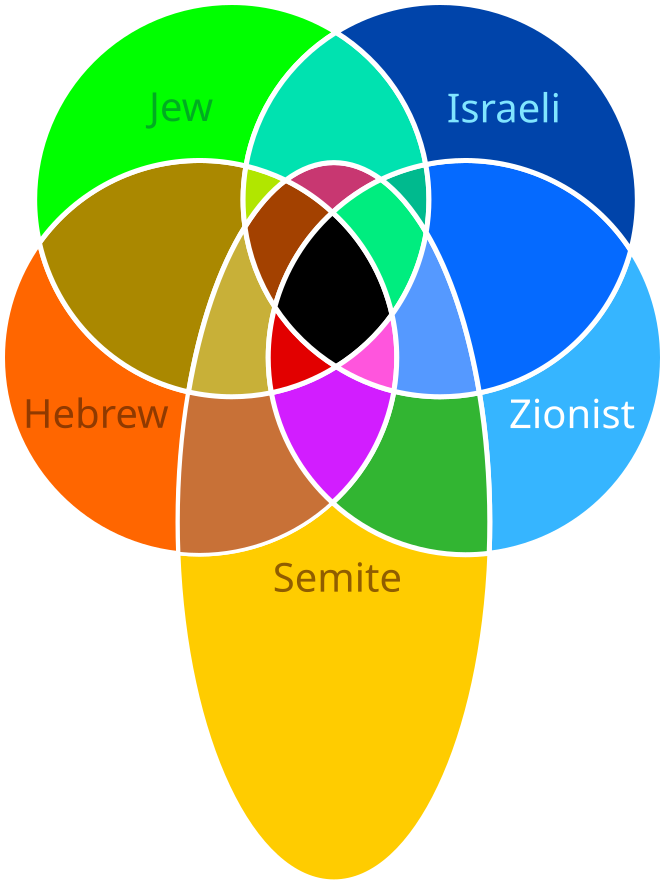
You can see how confusing it gets. If it was a board game, you’d probably want to kick the table over and walk away, and the diagram is a massive oversimplification of the full picture. Here are some examples:
Jew could refer to someone who identifies with Judaism, the religion, or who believes they are descended from the tribe of Judah and those it assimilated. There are Jews who are atheists, and non-ethnic converts to Judaism. So, Jew can mean at least three things: ethnic Jew, religious Jew, or ethnic religious Jew. However, ethnicity can be confusing too. According to official definitions of ethnicity, it could apply to the perception of shared ancestry, traditions, culture, or religion. So, some people may consider themselves ethnic Jews on the basis of their adherence to religious Judaism alone, blurring the lines between the initial distinctions. Also, it’s quite possible for an atheist Jew to not have ancestral lineage that dates back more than a couple of generations, but who identifies with the traditions of Judaism, and perhaps even partakes in some religious festivals out of social habit.
Israeli is a nationality; anyone who is a citizen of Israel can be described as Israeli. Israelis may be ethnically Jewish, religiously Jewish, or ethnically and religiously Jewish. Israelis can also be Muslim, Christian, or Druze. So, there can be ethnically Jewish Christian Israelis, ethnically Arab Druze Israelis, and so on. It is possible to apply for citizenship on the basis of naturalization, the requirement being to learn Hebrew and live in Israel for a few years, demonstrating intention to settle there permanently.
Hebrew refers to the ancestral lineage of the Jews, and their language. It includes those who predated the original tribe of Judah, and all tribes of Israel. Hence, Hebrew does not mean Israeli, nor Jew. Abraham and his family are considered Hebrew. This is a little problematic seeing as how his lineage, through Shem, also gave rise to Arab Muslims. As a language, it was revived to help solidify the ethnically-Jewish Israeli identity. People may refer to Jews as Hebrews, despite this not being technically equivocal. However, it’s less likely that Hebrew will lead to the same confusion as Semite because it will not generally be used in reference to non-Jews.
Semite is a term we have already examined, so revisit this above if need be. It refers to the speakers of Semitic languages, and is an ethnic origin, being all those descended from Shem. This includes Muslim Arabs.
Zionist is a person supporting Zionism, a movement that emerged in the 19th Century to foster support for the establishment of a modern Israel. Palestinian Arab territory was promised to Zionists in 1917, in a letter written to Lord Walter Rothschild by Lord Arthur Balfour, on behalf of the British establishment. It met with significant resistance, but came to fruition following World War II. Since Israel now exists, Zionist tends to be used to describe extremists who believe in expanding Israel to include its full historical territories from thousands of years ago, based on the authority of the bible. This would require the eradication of all the established communities who had lived there in the interim. However, Zionist may also be used to refer to anybody who believes in the continued existence of the Israeli state, and as such the word causes confusion, enabling those opposing extremist genocidal Zionism to be labelled as Jew-haters. Zionists can be non-Jewish, and non-Israeli, such as Racist American Christian Zionists. There can also be atheist ethnic Jewish Zionists, and non-ethnic religious Jews who are Zionists, among others. Zionists may also be Satanic, in the biblical sense, as the reformation of the historical Israel is said to invoke the end times when Satan gains full power over the earth. It is unlikely they will be open and honest about this; indeed, Satanists are quite likely to masquerade as their opposite—devout, godly nationalists, and award-winning leaders pressing for global peace. They’d do this while fostering war, and encouraging the murder of people on all sides of a conflict.
All this complication might make you want to say, ‘Hey, aren’t we all humans thrown into a random, pointless world full of suffering? Can’t we all just get along?’ And many people in the region try to do just that, both within Israel, and beyond the borders of its illegally occupied territories. However, if you stand to gain valuable land by identifying yourself with a group, or if your security and daily sustenance is dependent on identifying with a different group, one that opposes the first one, it makes things a bit complicated in practice. Despite that, some brave people still seek to transcend the fetters of historical classification, often making themselves targets of both sides, so it isn’t easy. And if you’ve seen your toddler daughter shot through the head, or your mum burned alive, you might discover a burning desire to seek allies and live for justice, or revenge. It would continue the bloody warfare, but it would be God’s will, right? I wonder what kind of God would give rise to a family that split into warring factions that went on to commit endless atrocities over thousands of years?
On the semantics of antisemitism, the IHRA say this:
The philological term ‘Semitic’ referred to a family of languages originating in the Middle East whose descendant languages today are spoken by millions of people mostly across Western Asia and North Africa. Following this semantic logic, the conjunction of the prefix “anti” with “Semitism” indicates antisemitism as referring to all people who speak Semitic languages or to all those classified as “Semites.” The term has, however, since its inception referred to prejudice against Jews alone.
Maybe it has been used in reference to Jews alone, but that doesn’t make it right, does it? After all, it’s a term that was deployed by idiotic racists. Why would you follow from their lead? The contorted logic of the statement itself should be enough to illuminate the stupidity of its conclusion. And who spoke this ‘family’ of languages we know as Semitic? Were they Semites? I think so. Were they all Jews? Nope. Running roughshod over language and history is one thing, but to then take issue with the minutiae of grammar, is quite something else …
The International Holocaust Remembrance Alliance (IHRA) would like to address the spelling of the term “antisemitism,” often rendered as “anti-Semitism.” The IHRA’s concern is that the hyphenated spelling allows for the possibility of something called “Semitism,” which not only legitimizes a form of pseudo-scientific racial classification that was thoroughly discredited by association with Nazi ideology, but also divides the term, stripping it from its meaning of opposition and hatred toward Jews.
What’s this? The inclusion of a hyphen is anti-Jewish antisemitism because anti-Semitic doesn’t mean the hatred of Jews, antisemitic does. And this is because Semite is a pseudo-scientific racial classification used by Nazis, so anti-Semite would be too, but antisemite isn’t. There’s no congruity or sense to this at all. It’s almost like a deliberate attempt to discourage anybody from attempting to talk about it, isn’t it? Maybe there’s a clearer way of expressing things? How about anti-Jewish? Clearer, right? So, why not use it? Perhaps it’s because antisemitism, as a term used exclusively to refer to Jews, helps obfuscate and destroy the ancestral history of the region’s Arabs, including those living in the occupied State of Palestine. Semites, whose bodies are now being eradicated along with their homes and their history.
https://holocaustremembrance.com/resources/spelling-antisemitism
Burge, L. (1888). Aryas, Semites and Jews: Jehovah and the Christ. Lee and Shepard.
Jackson, J. W. (1869). The Aryan and the Semite. The Anthropological Review, 7(27), 333-365.